How Player Community Insights Drive Innovations in Online Table Game Offerings Across International Networks
Written by Viktor Krüger · Nov 1, 2026

How Player Community Insights Drive Innovations in Online Table Game Offerings Across International Networks
Player communities across global networks have long fed data into development cycles for online table games, and operators track forum threads, in-app polls, and social media clusters to identify recurring requests for rule tweaks or new variants. Researchers at academic institutions have documented how these aggregated signals translate into feature rollouts, with one study tracking patterns from 2024 through late 2026 showing direct correlations between community volume on specific mechanics and subsequent code deployments.
Feedback Channels That Shape Table Game Updates
Operators maintain dedicated moderation teams that monitor Discord servers, Reddit subgroups, and proprietary chat logs where players discuss blackjack side bets or roulette wheel biases. Data from these sources gets parsed through natural language tools that flag repeated phrases about speed of play or payout structures, then those metrics route to product teams for prioritization. In regions such as Southeast Asia and parts of Europe, seasonal spikes around cultural events produce concentrated input that operators route into limited-time table configurations released in November 2026.
External partnerships with research bodies add another layer. The Australian Gambling Research Centre has published datasets that map player sentiment clusters to retention metrics, while the Canadian Centre for Gaming Research has examined how cross-border poker networks incorporate suggestions from multi-language player groups. These reports supply operators with benchmarks they compare against internal telemetry before committing resources to interface changes.
Regional Patterns in Community-Driven Feature Adoption
Networks serving European markets often prioritize community requests for customizable dealer speeds and multi-hand options after forums highlight frustration with fixed pacing during peak hours. Meanwhile platforms focused on Asia-Pacific audiences incorporate more frequent requests for community-voted jackpot triggers in baccarat variants, reflecting documented preferences for shared prize pools. Observers note that these differences emerge because player density and preferred communication platforms vary by jurisdiction, producing distinct input volumes that development pipelines then reflect.
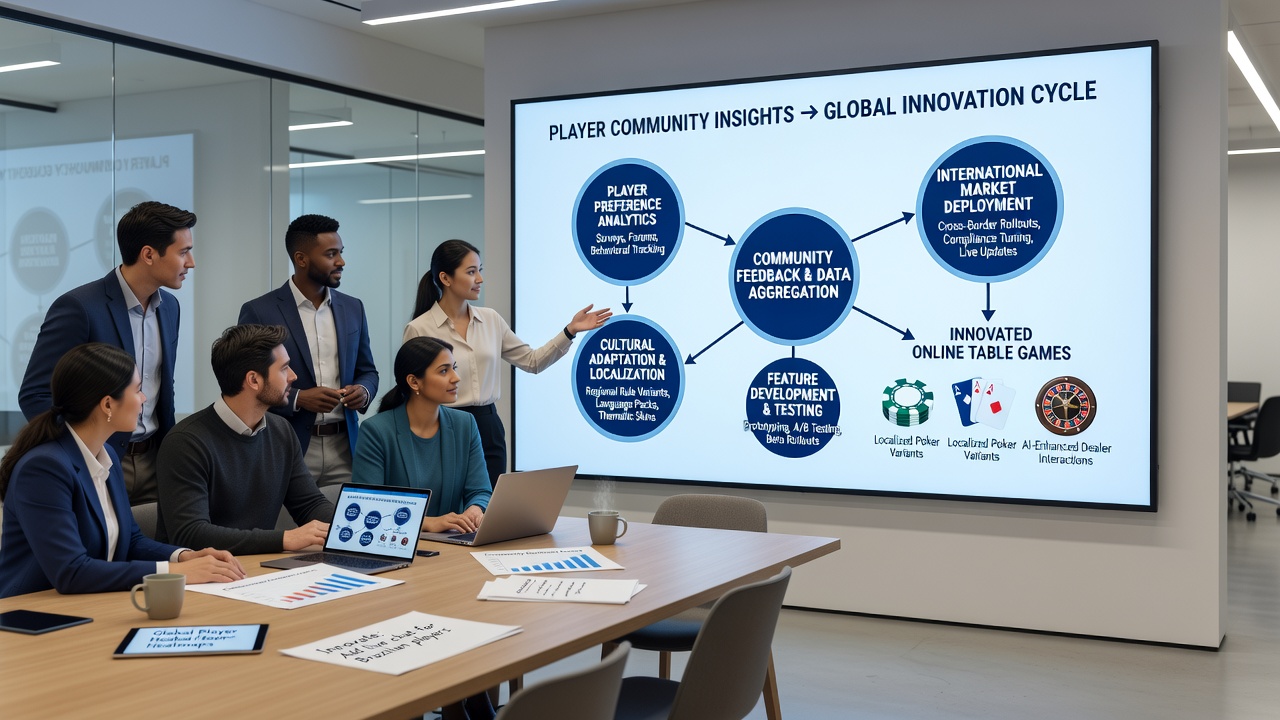
One documented case involved a Latin American network that introduced a community-proposed three-card poker variant after repeated mentions across Spanish-language channels reached critical thresholds in early 2026. Deployment occurred after operators cross-checked engagement data against regulatory guidelines from the Malta Gaming Authority and similar bodies in other territories. The rollout coincided with broader platform updates timed for November 2026, when several operators synchronize calendar events with regional holidays to maximize testing participation.
Measurement of Impact on Retention and Variety
Industry reports indicate that networks incorporating community-sourced table game adjustments record measurable lifts in session duration and repeat visits compared with static offerings. Figures released by the European Gaming and Betting Association show operators that publish public roadmaps based on player polls achieve higher completion rates for new feature testing phases. These metrics emerge because players who see their input reflected tend to remain within the same ecosystem rather than migrating when preferences shift.
Cross-network synchronization tools now allow operators to compare community datasets across borders in real time, reducing duplication of development effort while respecting local compliance rules. Academic analyses of these systems highlight how latency in feedback processing correlates with slower innovation cycles, prompting several major platforms to allocate dedicated engineering hours to community data pipelines during 2026.
Conclusion
International table game networks continue to refine methods for converting player community signals into deployable features, drawing on aggregated data from multiple regions and validated through partnerships with research organizations. Patterns observed through 2026 demonstrate consistent linkages between structured input collection and targeted updates that expand game variety while maintaining regulatory alignment across jurisdictions.